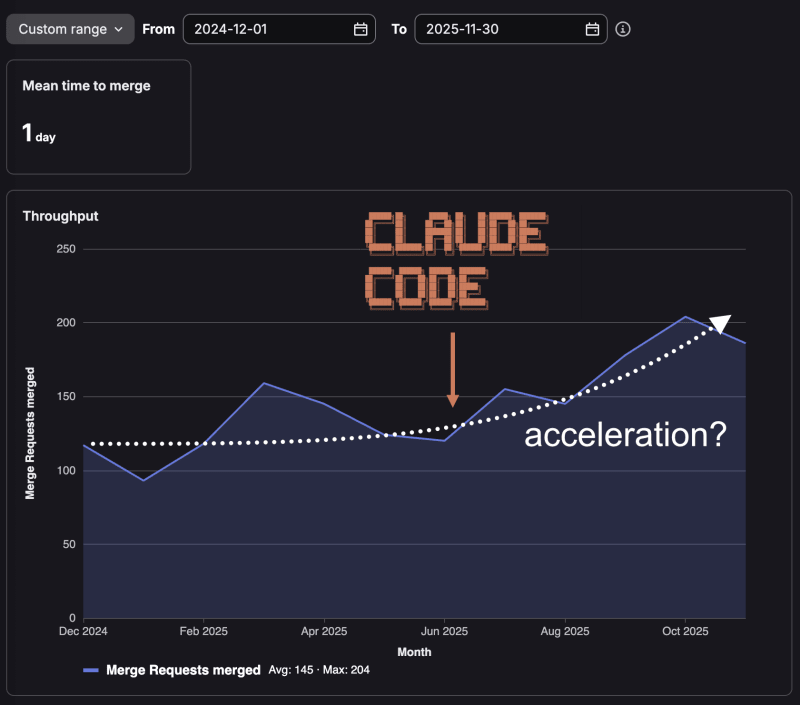
Last week, I posted about AI coding tools and engineering productivity. It got more attention than expected and sparked a debate in comments I didn't anticipate: Is the merge request rate a good measure of productivity?
Fair question. Here's my take:
I used the rate of merged MRs as a proxy metric for productivity. Like all proxies, it's imperfect, but I think it's better than most alternatives, at least in our case.
If you can break a complex feature or refactoring into multiple small, independent MRs, that's not gaming a metric. That's good engineering. Your reviewers will thank you, and your users will benefit. More power to you!
If you're gaming a metric, or worried that others are, the issue isn't the metric. It's your company culture.
So yes, for our company at our current stage, with our team and culture, I believe the rate of merged MRs is a useful signal for engineering velocity.
For what it's worth: at Ren Systems, we don't measure engineers by MR rate or any similar metric. Neither individually, nor collectively. I shared this observation as a quantifiable measure of the acceleration we feel as a team in our daily work.
But this debate is secondary to my main point: I wasn't claiming AI made us magically faster. The observation was that our merge rate increased. The argument was that strong foundations are the reason we're accelerating.
Are AI tools contributing? Probably. But they're not the cause. They're the amplifier.