Taste and judgment have become the new buzzwords of the product world. Everyone agrees they matter more than ever, but I’ve rarely seen anyone define them precisely. So here’s my attempt, in computer science terms.
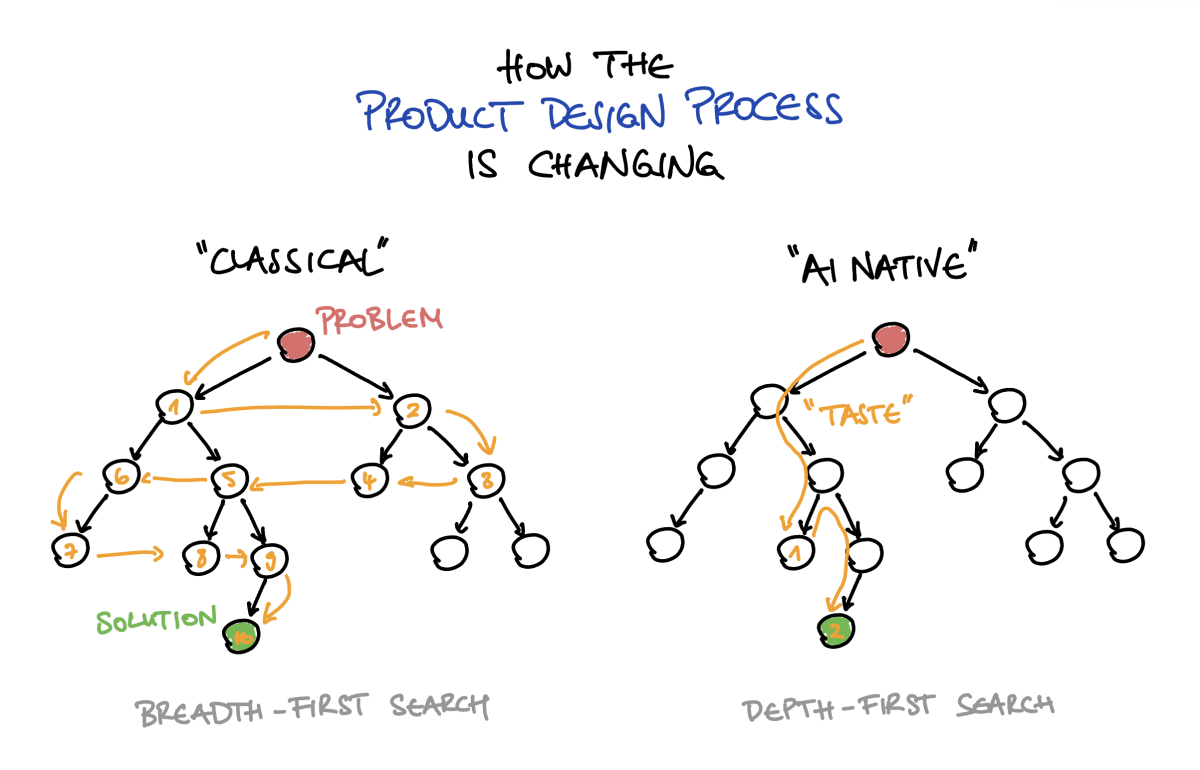
The classical product design process is a breadth-first search. You extensively map the problem space, interview a lot of users, explore many directions with low-fidelity prototypes, and only commit to one solution late. The process is deliberately systematic, which means it protects you from your own bad intuitions and biases by exploring the whole decision tree. It guides the search for you, at the cost of speed.
With AI, the process is becoming a depth-first search. Now you can go from a rough idea to a production-looking prototype in a few hours, effectively committing to one branch of the tree without ever having explored the others. Taste or judgment, then, is the ability to intuitively direct that depth-first search. It’s picking the right branch early, sensing when a path is a dead end, and knowing when to backtrack instead of digging deeper. Someone with great early judgment finds the solution in a fraction of the time. But if, and only if, their early decisions are right a lot more often than not.
The goal isn’t to skip the classical work. User research still matters, but I think that you can learn much faster from a working prototype than from an abstract discovery phase. Therefore, you can use the same activities in a more directed way and with a larger step size per iteration.
The danger is that every artifact generated with AI looks finished because it produces polished prototypes by default. Before, a prototype earned its polish through deliberate human effort, so its looks told you something about how well the underlying idea had been worked out. Because this signal is now gone, we have to communicate much more explicitly where in the design process a prototype sits.
I think the people who will thrive in the new process are product managers and designers who can also build, and experienced engineers with real product and business sense. Both can traverse the tree quickly, and most importantly, have the judgment to save a lot of time by being directionally right in many of their early decisions.
Recent articles
- Hyphens and Dashes - 16th March 2026
- Context Windows Are Limited by Atoms, Not Bits - 1st March 2026
- My Own Little Corner of the Internet - 22nd February 2026