Started: 14th November 2023
Finished: 6th December 2023
Summary
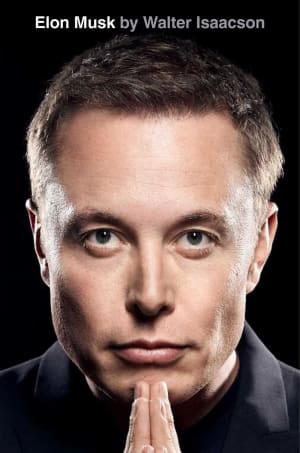
A sweeping biography of Elon Musk, tracing his turbulent childhood in South Africa through the founding and scaling of PayPal, SpaceX, Tesla, Neuralink, and his acquisition of Twitter. Isaacson, who shadowed Musk for two years, captures both the relentless intensity that drives his companies and the personal chaos that surrounds him, offering an intimate, unvarnished look at one of the most polarizing figures in technology.
My Thoughts
I haven't followed Elon Musk closely until reading this book, and I get raised eyebrows when I mention having read his biography. However, reading about someone isn't the same as agreeing with them, and there's plenty to learn here regardless of where you stand.
Musk has a pretty unique ability to cut through complexity and jargon, reducing things to their simplest possible form. If you're not interested in the personal drama, the most valuable part of the book is Isaacson's documentation of Elon Musk's "Algorithm", a set of principles he applies to everything. It's extreme in some respects, but it contains a lot of truth.
My main criticism: by the time the book was published in September 2023, Musk's story was far from over. His involvement in the 2024 election and the second Trump presidency hadn't even begun. Compared to Isaacson's classic biography of Steve Jobs, which ended with Jobs' funeral and could contextualize an entire life, it feels too early to do the same for Musk.
Elon Musk’s Algorithm
The Algorithm
- Question every requirement. Each should come with the name of the person who made it. You should never accept that a requirement came from a department, such as from "the legal department" or "the safety department." You need to know the name of the real person who made that requirement. Then you should question it, no matter how smart that person is. Requirements from smart people are the most dangerous, because people are less likely to question them. Always do so, even if the requirement came from me. Then make the requirements less dumb.
- Delete any part or process you can. You may have to add them back later. In fact, if you do not end up adding back at least 10% of them, then you didn't delete enough.
- Simplify and optimize. This should come after step two. A common mistake is to simplify and optimize a part or a process that should not exist.
- Accelerate cycle time. Every process can be speeded up. But only do this after you have followed the first three steps. In the Tesla factory, I mistakenly spent a lot of time accelerating processes that I later realized should have been deleted.
- Automate. That comes last. The big mistake in Nevada and at Fremont was that I began by trying to automate every step. We should have waited until all the requirements had been questioned, parts and processes deleted, and the bugs were shaken out.
Corollaries
The algorithm was sometimes accompanied by a few corollaries, among them:
- All technical managers must have hands-on experience. For example, managers of software teams must spend at least 20% of their time coding. Solar roof managers must spend time on the roofs doing installations. Otherwise, they are like a cavalry leader who can't ride a horse or a general who can't use a sword. Comradery is dangerous. It makes it hard for people to challenge each other's work. There is a tendency to not want to throw a colleague under the bus. That needs to be avoided.
- It's OK to be wrong. Just don't be confident and wrong.
- Never ask your troops to do something you're not willing to do.
- Whenever there are problems to solve, don't just meet with your managers. Do a skip level, where you meet with the level right below your managers.
- When hiring, look for people with the right attitude. Skills can be taught. Attitude changes require a brain transplant.
- A maniacal sense of urgency is our operating principle.
- The only rules are the ones dictated by the laws of physics. Everything else is a recommendation.
On Elon Musk by Walter Isaacson (p. 285)