Thursday, 7th May 2026
Appearing Productive in The Workplace. A nuanced, well-written blog post on the dangers of using AI in the workplace.
The author identifies two distinct failure modes:
Generative AI can produce work that looks expert without being expert, and the failure arrives in two shapes. The first is when novices in a field are able to produce work that resembles what their seniors produce, faster or more advanced than their judgment. The second is when people generate artifacts in disciplines they were never trained in.
Another interesting observation is on workslop, now that the cost of producing a document has fallen to nearly zero:
Requirements documents that were once a page are now twelve. Status updates that were once three sentences are now bulleted summaries of bulleted summaries. Retrospective notes, post-incident reports, design memos, kickoff decks: every artifact that can be elongated is, by people who do not read what they produce, for readers who do not read what they receive.
The author also writes about the implications for companies, which is a view I share:
For firms, the competitive advantage of a firm whose work can be trusted has not disappeared; it has, if anything, appreciated, because so many of the firm’s competitors are quietly converting themselves into content-generation pipelines and counting on the client not to notice.
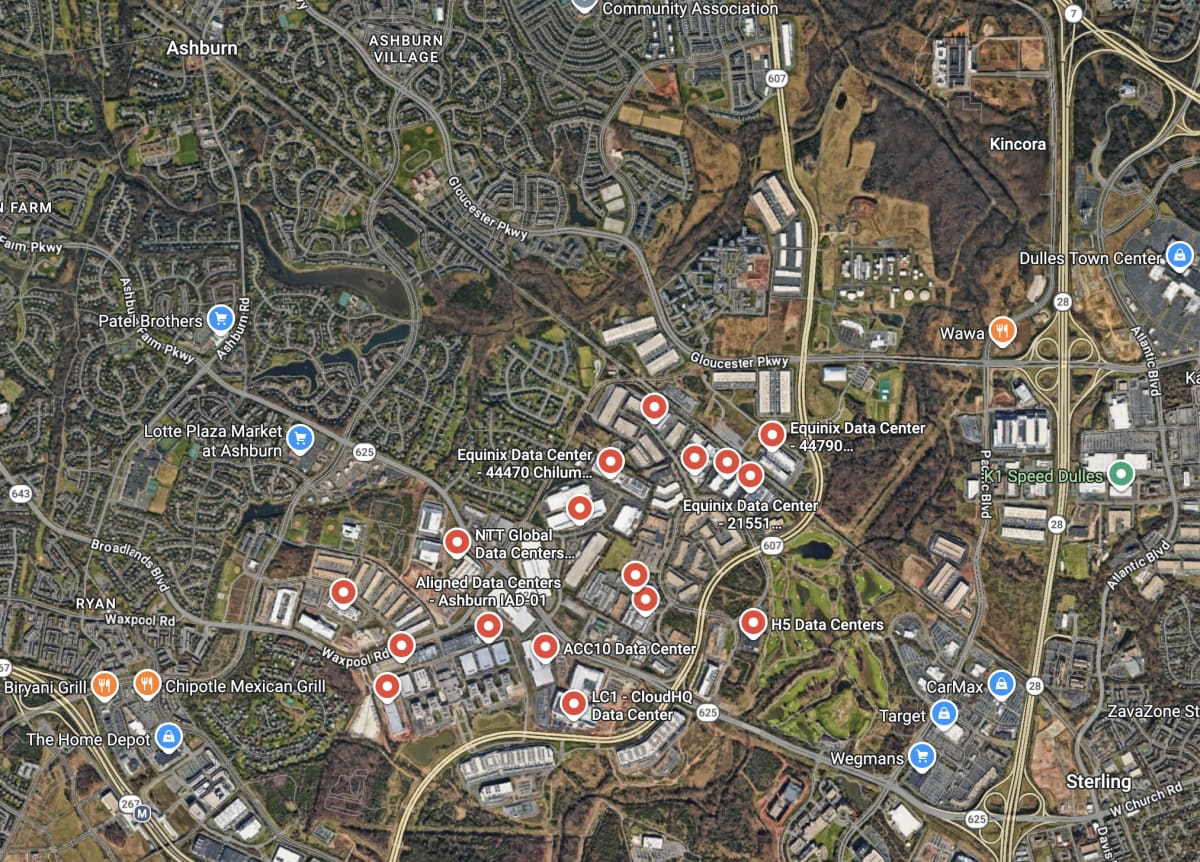
Have you ever wondered what “the cloud” actually looks like? It’s a lot more physical than it sounds.
This Google Maps screenshot shows the so-called “Data Center Alley” in Ashburn, Northern Virginia—a cluster of warehouse-sized data centers located between a golf course and a few suburbs that look like they’re straight out of an American movie. AWS’s famous us-east-1 lives here, along with data centers from Microsoft, Google, Meta, IBM, Oracle, and many others. According to a frequently cited estimate from the local economic development office, around 70% of the world’s internet traffic passes through here. I have some doubts about whether this estimate is still accurate, but it is likely the world’s largest concentration of digital infrastructure.
As a software engineer or AI builder, it’s easy to forget that whatever services you call or build on, your code is actually moving photons through optical fibers and electrons across silicon somewhere, drawing real power from an electrical grid. AI is progressing really quickly right now, but the underlying physical infrastructure imposes constraints on how much of that progress is actually deployable.