February 2026
13 posts: 1 entry, 5 links, 2 quotes, 4 notes, 1 book
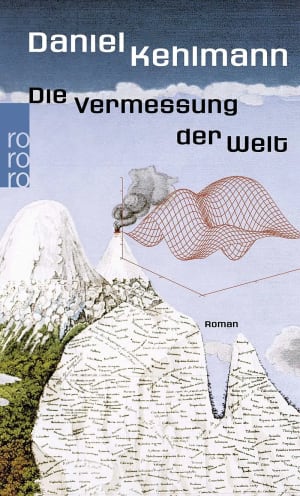
Aber während die ersten Vororte Berlins vorbeiflogen und Humboldt sich vorstellte, wie Gauß eben jetzt durch sein Teleskop auf Himmelskörper sah, deren Bahnen er in einfache Formeln fassen konnte, hätte er auf einmal nicht mehr sagen können, wer von ihnen weit herumgekommen war und wer immer zu Hause geblieben.
— Daniel Kehlmann, Die Vermessung der Welt
Die Vermessung der Welt
The story has two main themes: experimental vs. theoretical science and aging. [... 153 words]
Can humans make AI any better? Another great Welch Labs video about the bitter lesson, contextualizing the recent Dwarkesh interview with Rich Sutton.
Many people misunderstand the bitter lesson. It's not that some solutions are "past" it while others aren't. It's a ladder of increasingly general approaches to the same problem, with a persistent tradeoff between heuristics that perform well now versus general methods that win in the long term, given enough compute.
OpenClaw took the internet by storm last week. It's obviously a security nightmare, but its viral success confirms something I've believed for a while: most AI products today are fundamentally limited by requiring too much agency from their users.
There's real demand for AI that works for you, not just with you. A system that monitors, anticipates, and acts proactively instead of waiting for your next prompt.
At Ren Systems, we've been building exactly this kind of product: AI that works on behalf of the user and surfaces what matters before they ask for it. There's something almost magical when an AI system works this way.
Proactive AI is where the next value unlock lies. But building it in a way that's secure and compliant isn't something you can prompt out of Claude Code overnight.
An Interview with Benedict Evans About AI and Software. Benedict Evans articulates a great insight really well here: LLMs might be a real threat to recommender system moats.
The playbook to build a flywheel has been the following: build a platform, measure engagement data, find patterns, and make better recommendations to attract more users. That's the network effect that made Google, Meta, and Amazon so hard to compete with. But LLMs have a compressed representation of that same knowledge from training on vast amounts of the internet, without having to measure engagement of real users.
To overcome the cold-start problem, you don't need years of engagement data anymore. Now you can just give an LLM some context of a user, for example their social media profile, to get high-quality recommendations. It's a fundamentally different entry point to personalization, one that doesn't depend on scale.
For the first time, you can build a competitive recommender system without a single user.
The playbook behind the flywheel of many of the most powerful companies has been: build a platform, measure engagement data, identify patterns, and make better recommendations to attract more users. That's the network effect that made Google, Meta, and Amazon so hard to compete with.
But LLMs have a compressed representation of that same knowledge from training on vast amounts of the internet. So to overcome the cold-start problem, you no longer need to measure and train on years of engagement data from your own users.
Now you can just give an LLM some context of a user, for example, their social media profile, to get high-quality recommendations. It's a fundamentally different entry point to personalization, one that doesn't depend on scale.
Are LLMs about to break the recommender-system moat?
An Interview with Ben Thompson by John Collison on the Cheeky Pint Podcast. John Collison and Ben Thompson sketch out four levels of agentic commerce in this interview. I like that they start from the bottom up instead of jumping to the far end state.
- Reduce friction. Agents that fill out web forms on your behalf. You paste a product URL into ChatGPT and say "buy this for me."
- Contextual search. Natural language queries with real context: "I need a jacket for -10°C in the Alps" instead of guessing keywords.
- Persistent preference profile. A profile the agent builds over time from your pins, browsing history, or style boards.
- Proactive recommendations. Don't wait for the user to search: anticipate what they need and surface it at the right time. Thompson's point is that this already exists at scale. Zuckerberg called Meta's ad platform the most successful agent in the world.
Interesting to think about how these four levels apply to Ren and other AI products. At Ren, we started from the hardest end, level 4, with proactive recommendations.
One could arguably add a level 5: full autonomy. The agent doesn't just recommend, it acts. OpenClaw is the most visible example right now: a local AI agent that browses, buys, books, and executes on your behalf without waiting for approval at each step.
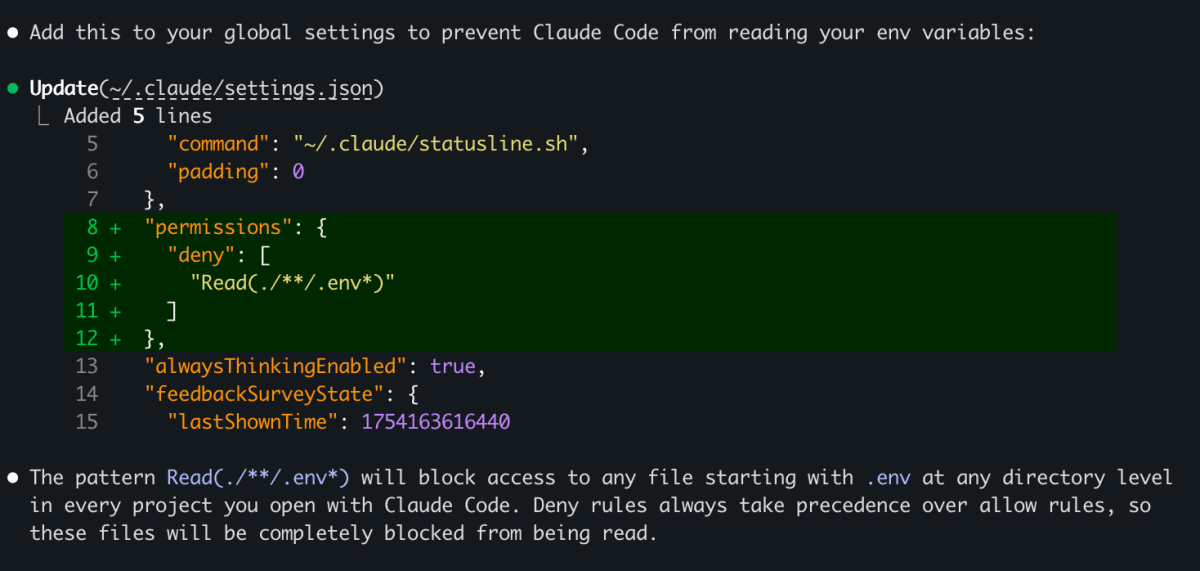
If you're using Claude Code or other coding agents, check whether they have access to your secrets. Many developers assume .env files are protected by default, but they are not.
In Claude Code, the interactive permission prompt is the only barrier, and it's easy to click through without thinking. To fix this, you can add a deny rule in your global Claude Code settings (see screenshot).
It takes 30 seconds to set up, and it's the kind of thing you only think about after something goes wrong.
Boris Cherny (creator of Claude Code) on Lenny’s Podcast. I hadn't come across the term "latent demand" before this podcast, and Boris Cherny calls it the single most important principle in product. The idea of latent demand is to watch how users misuse or hack your product to solve their own use cases, and then build specifically for that. Cherny also extends this to AI. With AI products, you should observe what the model/agent is trying to do (e.g., which data it wants to access, which tools are missing, or it has to chain together that could be implemented in a use-case specific tool call), and make that easier.
Cherny also had an interesting comment on innovation. You can't force it, but you have to give people space and psychological safety to fail, but cut ideas that aren't working. Claude Code itself wasn't explicitly on the roadmap, and it wasn't an obvious hit at launch.
He also shared an interesting observation on how roles in and around product are changing with AI. Everyone on the Claude Code team—engineers, PMs, designers, etc.—codes, but with a different angle. He thinks the term "software engineer" might disappear by the end of the year and be replaced by something broader, like "builder".
My Own Little Corner of the Internet
An internal initiative at work encouraging everyone to post on LinkedIn turned into me posting regularly, and some of those posts attracted quite a bit of attention and profile views. This made me realize that I didn’t really have a place where interested people could learn more about me. My LinkedIn profile was my most public page on the internet and I wanted somewhere else for people to go, something more under my control. Creating my “own little corner of the internet” has been a goal of mine for a long time, and this is what pushed me over the edge to finally do it.
[... 771 words]Is this where LLMs picked up their famous sycophantic phrase and behavior?
Currently reading Conscious Business by Fred Kofman, a classic on values and authentic communication at work, and stumbled across this on page 57.

On Conscious Business by Fred Kofman
10 Years Building Vertical Software: My Perspective on the Selloff. Nicolas Bustamante, who has built vertical software on both sides of the LLM disruption (Doctrine for legal, Fintool for equity research), wrote a moat-by-moat analysis of vertical SaaS that is worth reading. In his view, five moats collapse (learned interfaces, custom workflows, public data access, talent scarcity, and bundling), while five hold (proprietary data, regulatory lock-in, network effects, transaction embedding, and system-of-record status).
A few things I think are missing. The biggest threat to vertical software incumbents probably isn't scrappy AI startups building 80% of the features at 20% of the cost (like his new Fintool company). It's that products like Claude Cowork can do 80% of what vertical software does out of the box, with general agents and data access, at marginal implementation cost. Once integrated, enterprises might trust Anthropic, OpenAI, and Google more than they trust a vibe-coded startup.
There's also a scenario Bustamante doesn't address: LLMs themselves will likely commoditize. If that happens, model providers will have to fight for companies and startups to use their tokens. That's precisely why Anthropic, OpenAI, and Google are strongly pushing into the product space themselves, because products might be more defensible than models. This raises an uncomfortable question for Bustamante's own company, Fintool, which he doesn't address. If what they built is, as he describes, essentially markdown skill files integrating with MCPs and foundation model APIs, what's their justification against the model providers doing the same thing?
I think for anybody in any field, if they write about the edge of what's happening in their field, [...] it really hones your thinking, because when you write something down and you do it all the time, there's this inner desire to not be intellectually inconsistent and so you hold yourself actually to understanding things. Going back to that word nuance, you really get into the nuance because you really want it to hold together once you put something down on paper and there are plenty of people outside of ourselves that have studied this writ large, but it's very well understood that writing is a great way to understand things to take it to a higher level.
— Bill Gurley, Stratechery interview about Gurley's book Runnin' Down a Dream